 The disappearance of John the Baptist
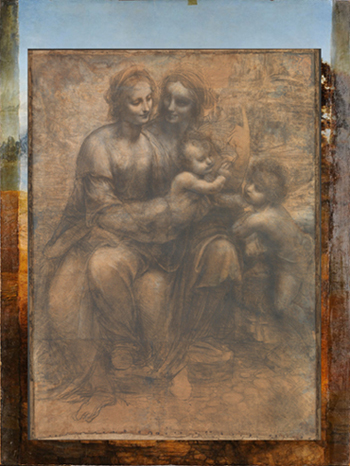
The image on the left shows the Louvre's St. Anne and Madonna and Child with the Burlington House carton overlaid on top, with the vertical dimensions adjusted to 168cm and 141cm, respectively.
As you can see in the image, they fit together perfectly. In the Burlington House carton, John the Baptist's left foot extends beyond the screen, but this board fits perfectly. Thus, this board may have originally been prepared for the Burlington House carton.
However, a big question remains as to why Leonardo did not complete the Burlington House version as is.
The answer is John the Baptist.
The client of St. Anne and Madonna and Child was Louis XII. The French king, who was plotting to advance into Italy and waging war, had no need for a Madonna and Child depicting the patron saint of Florence.
Therefore, I believe that the reason there are two versions of the Virgin and Child with St. Anne is that either John the Baptist was removed from the painting at the request of Louis XII, or he was not depicted out of consideration for Leonardo.
|
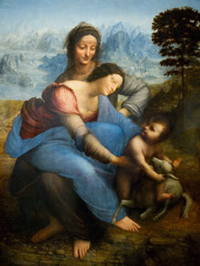
Virgin and Child with St Anne, c.1503-1519Oil on poplar, 168.4 x 113cm Paris, Musee du Louvre
Several preparatory sketches by Leonardo for this painting remain, and they are divided into parts. In particular, there are many sketches around the waist of the Virgin Mary, which shows that he put a lot of thought into the design. This is Leonardo's usual method of drawing, in which he first decides on the overall composition with small sketches, then prepares sketches for each part, and combines them to create the overall picture. This procedure is also described in Leonardo's notes and painting theory, and is Leonardo's painting philosophy. However, this unique Leonardo drawing method also causes some inconsistencies. For example, the length from St. Anne's waist to her knees is unusually long, which is clearly an anatomical inconsistency. Leonardo was so passionate about anatomy and drew countless sketches, but in his actual paintings, we can see that he placed more emphasis on the composition of the picture than on anatomical matters. No matter how talented an artist is, in later years their style becomes stylized and loses its dynamism. Leonardo's painting of the curly hair on the head of the infant Jesus shows signs of this. The colorful rhythmic changes seen in the Virgin of the Rocks are lost, resulting in a monotonous rhythm with little variation. This is probably due to the limitations of his age. The outlines of the right hand of the Virgin Mary and the hands of the infant Jesus Christ are also blurred, and the brushwork is far from that of Leonardo's heyday. The shadows on Jesus' face also extend beyond the intended range and are depicted slightly black and crushed. Perhaps he was losing the freedom of his dominant hand when he was painting this area. Antonio de Beatis, who visited Leonardo in 1517, recorded in his diary that Leonardo's condition was "paralyzed in the right hand." Regardless of whether it was his right hand or not, I feel that it is quite possible that Leonardo's hand was somewhat disabled.
|

leonardoresearch.jp